¶ 3.1 Resource Access Regulations, stakeholder roles and Responsibilities.
Echuya CFR is surrounded by a highly populated and degraded landscape with limited capacity to provide the forest resources required by the population. This has placed a lot of pressure on forest reserve which is increasingly getting degraded. There is need to regulate access to forest resources and put in place mechanisms for provision of alternatives and addressing degradation on private land.
¶ 3.1.1 Summary of resource access categories
| Permitted with strict rules | Not permitted at all |
|---|---|
| Firewood for domestic use | Hunting |
| Craft materials | Grazing |
| Herbal medicines | Scrapping/removal of humans and sand |
| Bee keeping | Harvesting of grass from Muchuya wetland |
| Water for domestic use | Harvesting of Smilax (Ensuri) and bamboo |
| Access to cultural sites for cultural rituals | Commercial firewood collection |
| Eco-tourism attraction | Cutting live trees for firewood, poles |
| Water for livestock | Cutting of bean stakes |
| Cultivation and settlement in the forest |
¶ 3.1.2 Firewood access and promotion of energy saving cookstoves
Introduction
The demand for firewood in around Echuya CFR is high. Residents of Murora Sub-county district depend on the CFR for most of their fuelwood requirements and (97%) of the households in sub-counties around Echuya CFR use the traditional 3-stove cookstove for cooking. A household of about 6 people utilizes 7 firewood per week when utilizing the 3-stone. When converted to cubic metres, 1 bundle is equivalent to 0.3333m3; thus, one household consumes 2.3m3 of firewood per week.
In monetary terms, each bundle of firewood is worth UGX 2,000 around Echuya CFR. Therefore, one household utilizes firewood worth UGX 14,000 per week. Under the expired CFM Agreement, the Batwa community were given open access rights to firewood as a mechanism of supporting them meet their daily livelihood needs from the sale of firewood. This opportunity was also used by non-Batwa to collect firewood on a daily basis.
The in-forest assessment in Echuya CFR indicated that dry firewood had been wiped out in areas next to the community. The local community had resorted to cutting live trees and stumps of trees for firewood.
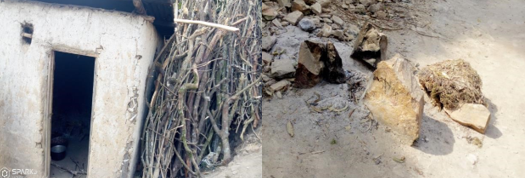
Fig 2: LEFT: Firewood collection from Echuya CFR and RIGHT: An open place used as cookstove energy saving cookstove in Rugyeshi village
Firewood access regulations
It has been agreed that the following regulations will be adhered to in accessing fire wood from Echuya CFR.
a) Firewood collection will be collected by MEFCPAA, Batwa and other members of the community;
b) Only dry will be permitted for collection as firewood and only for domestic use;
c) Non Batwa community members will collect fire wood every Saturday from 12.00 a.m to 3.00 pm;
d) The Batwa community will collect fires for 3 days in a week; on Monday, Wednesday and Saturday, between 12.00am to 3.00pm.
e) A maximum of two people per household will be allowed to collect firewood.
f) Each household will be allowed a maximum of 2 people and 2 bundles of firewood on each collection day;
g) Both Batwa and non-Batwa will not be allowed to pangas during fire collection;
h) Children below 10 years shall not be allowed to collect firewood from the forest; and those above 10 years should only collect on a Saturday
i) All households should have improved energy saving stoves and well-constructed kitchens within 6months after signing the agreement to minimize usage of firewood;
j) MEFCPAA will put in place a firewood user committee in to monitor fire collection during fire collection days;
k) As an alternative, the community members are urged to plant their own trees through agroforestry and for those who already have; to start using their own trees for firewood.
l) Murora sub-county Local government to put in place and enforce by-laws on each household to have energy saving cookstoves
Roles and responsibilities of stakeholders
Roles and Responsibilities of Firewood collectors
a) Report any illegal activities identified in the forest;
b) Abide by the set regulations on firewood collection;
c) Avoid indulging in any other activity in the forest apart from firewood collection;
d) Construct good kitchens and energy saving cook stoves to reduce on fire wood consumption;
e) Plant trees in their respective homes as an alternative source of firewood.
i) Roles and responsibilities of MEFCPAA Executive Committee
a) Monitor harvesting and utilization of firewood to ensure that it is only dry wood is being collected used for domestic use/cooking only;
b) Monitor availability of firewood in designated collection areas;
c) Conduct sensitizations and mobilize community members to construct kitchens and use energy saving stoves;
d) Coordinate practical training on energy saving stoves;
e) Monitor the construction and use of energy saving stoves;
f) Document and share reports with other stakeholders;
g) Conduct community sensitization on the need to plant trees to provide firewood as a means reducing pressure on the forest reserve;
h) Coordinate with firewood user group committees on matters related to fire wood;
i) Identify, warn and eventually report those involved in illegal firewood collection and cutting of live trees to NFA.
ii) Roles and responsibilities of NFA;
a) Assess and monitor availability of firewood on a regular basis and together with MEFCPAA members and agree on a way forward based on the prevailing status;
b) Create awareness on the need to save energy;
c) Arrest and apprehend those involved in illegal activities in courts of law;
d) Conduct Sensitization of local community on the need to plant trees;
e) Provide technical support on tree nursery management and planting.
iii) Roles and responsibilities of Murora sub-county and Kisoro district local governments
a) Provide technical support to the local community on construction of energy saving stoves and tree growing activities;
b) Promote other renewable energy sources like biogas where feasible;
c) Settle disputes arising from resource access activities;
d) Maintain records on construction and use of energy savings cook stoves and tree planting;
e) Provide skills development in Tree nursery establishment and management;
f) Put in place by-laws and ordinances on compulsory use of energy saving cookstoves;
Promotion of energy saving cook stoves
As a mechanism for reducing firewood consumption and pressure on Echuya CFR, construction of energy saving cookstoves will be promoted under this plan. The strategy will be to encourage all community members starting with MEFCPAA to construct energy saving cookstoves in order to reduce firewood consumption. The campaign will involve promotion of construction and maintenance of kitchens at household level to host the cookstoves. The key players will include the Kisoro district forest officer, NFA, MEFCPAA, Murora Sub-county Local government and LC zero (self-help groups) and LC1.
Roles and Responsibilities of the KISORO District Forest Office
a) Co-ordinate stakeholders on conducting TOT on energy saving cook stoves
b) Link MEFCPAA to other stakeholders for support on construction of Energy Saving Cook stoves;
c) Monitor the construction and use of energy saving cook stoves;
d) Maintain records on the numbers of members using energy saving stoves;
e) Conduct assessments on fuelwood consumption in relation to the energy saving stoves in place.
Roles and Responsibilities of MEFCPAA
a) Identify members with knowledge and skills in construction of Energy Saving Stoves;
b) Mobilize members for training of trainers on construction of energy saving stoves;
c) Lobby for trainings on construction of Energy saving stoves;
d) Coordinate the construction of energy saving cookstoves with MEFCPAA/ community members;
e) Monitor construction, maintenance and use of energy saving stoves;
f) Sensitize people on the importance of energy saving stoves;
g) Keep on Records on the number of members using energy saving stoves;
h) Share reports with all stakeholders on progress being made on utilization of energy saving stoves;
Roles and Responsibilities of Zero LC/ LC1/Parish Chiefs
a) Mobilization of the community for use of renewable energy technologies;
b) Conduct sensitization of the community on renewable energy technologies;
c) Provide information on the number of H/Hs in the area;
d) Enforce construction of energy saving cookstoves;
Roles and Responsibilities of NFA
a) Assessing the status and demand of fuelwood consumption;
b) Sharing reports with stakeholders on firewood availability and demand;
c) Identify and link MEFCPAA to stakeholders to build capacity of members on energy saving stoves;
d) Monitoring construction and use of energy saving stoves
Benefits to stakeholders from firewood and use energy saving stoves
| Benefits to Kisoro District and Murora LGs | Benefits to the local community | Benefits to NFA |
|---|---|---|
| Increased tree cover on private land and protection of soil against erosion | Sustained supply of firewood | Reduced degradation arising from firewood collection |
| Healthy community | More time saved for other productive activities | Enhanced protection of the forest |
| Improved kitchen hygiene | Prevention of diseases caused by smoke in 3stone cookstoves | |
| Skills gained in stove construction | ||
| Source of livelihood for Batwa people |
Water for livestock
Livestock owners in Murora Sub-county water their livestock in Echuya CFR especially during the dry season. They also lack adequate pasture due to limited land holdings per household. Cattle owners therefore graze and water their animals in Echuya CFR. This has caused degradation especially in areas around water points such as Karandagyi and Kalurema. Given this situation it was agreed as follows;
No grazing will be allowed in the forest reserve
a) Livestock owners will be free to collect water from the reserve for their animals from home;
b) Alternatively, livestock owners should devise means of harvesting water during the rainy season which can also be used during the dry season;
c) Taking of animals for water in the forest reserve is allowed for the first three years from the date of signing the agreement after which the community will no longer be allowed to take their livestock to the forest for water.
d) Watering of livestock will be from 12.00pm to 3.00pm;
e) Livestock owners will fence both sides of route leading to the water point to prevent animals straying to the forest for grazing;
Roles and responsibilities of stakeholders
| Roles and responsibilities of NFA | Roles and responsibilities of MEFCPAA |
|---|---|
| Enforce the law against illegal grazing and apprehend offenders | Monitor and report illegal grazing to NFA |
Kisoro District Local Government
• Sensitize the local community on how to keep livestock without destroying the natural environment;
• Settle disputes related to grazing and watering of livestock;
• Where feasible develop a water supply plant to provide water from the CFR to community
¶ 3.1.3 Access to craft materials and craft making
Introduction
Craft making around Echuya CFR is a both lucrative business and also important for domestic use. The main crafts include mats and baskets which are made from fibres, grass, forest ropes and bamboo shoots. The dry season marks (December-January and June-August) the peak of craft making because many people have less work on the farm. Echuya CFR is main source of sources of craft materials in the surrounding sub-counties. The craft materials include bamboo shoots, grass from Muchuya wetland, ropes (emigoye); and climbers (emirondorondo).
The assessment found that Bamboo is extinct in part of Echuya CFR in Murora Sub-county while the desired grass for craft making is obtained from Muchuya Wetland which is nature reserve. Although the craft materials are harvested seasonally, the offtake levels exceed of some resources. Smilax (Ensuri) has been overharvested and very rare to get in Echuya CFR. Ropes are the only available craft material in Echuya CFR in MURORA subcounty. The shrinking quantities and species of craft materials, is a threat to the livelihoods of some people like the Batwa who depend on craft making and sale of craft materials is a routine business.
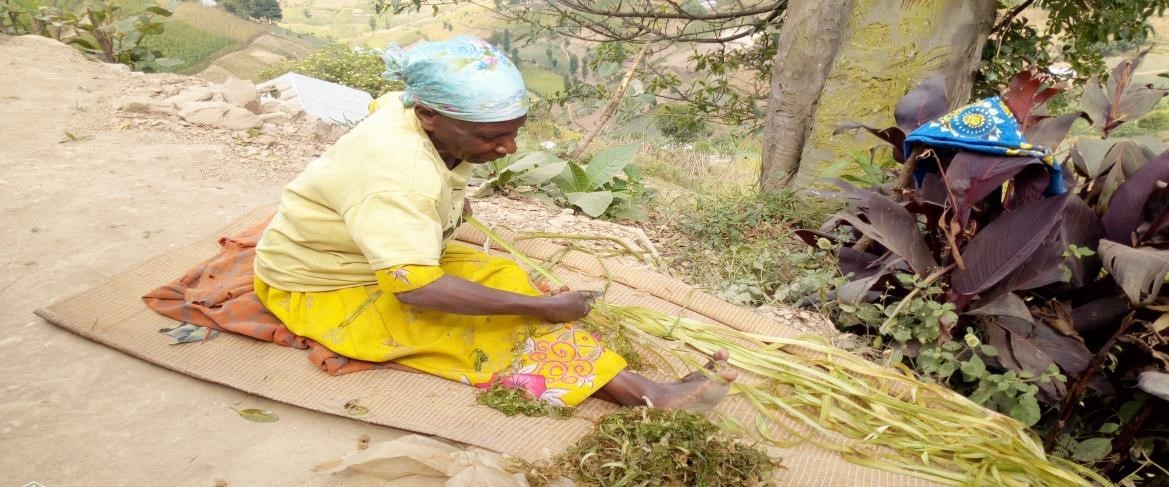
Figure 3: An elderly Mutwa woman in Rugyeshi village extracting fibres/Ropes obtained from Echuya CFR Regulations on extraction of craft materials
In line with the above background, it was been agreed as follows:
a) Harvesting of grass
Grass
While grass is one of the most important craft materials for making mats, it is located in Muchuya wetland which is part of the Strict Nature Reserve. The wetland is a habitat for endemic birds and mammals including the Grauler’s swamp warbler a globally threatened species and Albertine endemic mammals namely Woosnams Bush-Furred rat, Montane marsh rat and the climbing shrew. Continuous removal of grass contradicts the principles of strict nature reserves and is likely to interfere and further threat the endemic species.
Therefore, it has been agreed that grass will not be harvested from Muchuya wetland under this agreement. The NFA will instead develop tourism infrastructure in the wetland with participation of the local community in various ways such as tour guiding, music dance and drama and sale of locally made craft materials.
As an alternative, the local community will seek for other sources of grass especially in wetlands outside Echuya CFR. The Local community will also be trained in recycling plastic materials to make craft pieces.
b) Ropes (Emigoye)
i) Collection of ropes will be done in only in production and buffer zones (i.e not in Muchuya wetland)
ii) Collection of ropes will be carried out during June to August and December to January every year
iii) Non Batwa will collect ropes once a week every Saturday between June to August and December to January from 12.00am to 3.00pm;
iv) The Batwa will to collect ropes three times a week that is Monday, Wednesday, Saturday during June to August and December to January from 12.00am to 3.00pm
Most Batwa are landless and as they obtain a living through provision of farm labour and or extraction and sale of forest resources to other community members. During the dry season there is less farm activity and therefore limited jobs/employment for Batwa. The Batwa earn a living through collection and sale of craft materials or exchange of craft materials from the Echuya CFR with food. In order to sustain their livelihoods; it was agreed that the Batwa collect craft materials twice a week during the dry seasons.
v) All collections will be done between 12.00am to 3.00pm on each day designated for collection;
vi) The ropes will be collected, carried and processed outside the reserve to avoid littering the forest with rubbish;
vii) The left overs especially sticks can then be used as firewood;
viii) MEFCPAA members involved in harvesting of craft materials and craft making will form a user group with a user group committee (preferably comprising of Batwa, women and youth);
Roles and responsibilities
| Roles and responsibilities for MEFCPAA | Roles and responsibilities of NFA |
|---|---|
| a) Mobilize members to form the craft marking group | a) Assess availability of craft materials |
| b) Coordinate with NFA on access to craft materials | b) Issue licences/permits for harvesting of craft materials |
| c) Supervise extraction of craft materials | c) Monitor extraction of craft materials |
| d) Monitor and report cases of illegal extraction of craft materials | d) Link MEFCPAA to organizations for capacity building in craft making |
| e) Domesticate craft material species | e) Link the craft making user group to markets |
| f) Identify and protect and conserve sources of craft materials such as wetlands and river banks outside the forest reserve | f) Handle offences related to illegal extraction of craft materials |
| Roles and responsibilities of MEFCPAA crafts user group | Roles and responsibilities of MEFCPAA crafts user group |
|---|---|
| a) Adhere to sustainable harvesting methods for craft materials | a) Identify and support local communities to protect wetlands outside Echuya CFR |
| b) Report any illegal activities identified during harvesting of craft materials | b) Link the craft use group to capacity building opportunities related to craft making |
| c) Domesticate some species of plants which provide craft materials such as bamboo | c) Link the local community to markets for craft materials |
| d) Participate in the management of wetlands for sustainable production of craft materials | d) Settle conflicts related to craft materials |
| e) Acquire improved skills in production of high value and marketable craft pieces | |
| f) Maintain records of craft pieces produced and sold |
¶ 3.1.4 Access to herbal medicine
African traditions and norms have a strong attachment to herbal medicine and medicinal plants, while other plants have superstitious values. These strong traditions, norms, superstitions and tested curative herbal medicines drive local communities to make a choice between herbal medicine and modern medicine for various ailments. A variety of medicinal and superstitious plants exist in the forest and knowledge about them varies from one person to another and from tribe to tribe.
The Batwa for example rely on herbal medicine for treatment of various ailments. Their choice to use herbal medicine by Batwa is determined by their deep-rooted indigenous knowledge of the herbal plants but also the limited access to health centres on account of the discrimination they have undergone for several years by other tribes.
Medicinal plants are extracted from Echuya CFR mostly for domestic use although this trend is likely to turn commercial as herbal plants get extinct outside the forest reserve. Already, Prunus africana and Warbughia ugandensis have heavily debarked for commercial purposes. Under this plan the following herbal medicine access regulations will be applied.
Herbal medicine access Regulations
a) The local community adjacent to Echuya CFR will access herbal medicine for domestic use only
b) Commercial extraction of herbal medicine will not be allowed under this agreement unless authorized by NFA and consent of the MEFCPAA leadership;
c) Access to herbal medicine will be restricted to production and buffer areas. Harvesting of herbal medicine in the Strict Nature Reserve will not be allowed;
d) As much as possible uprooting a whole plant to access the roots for medicine should be avoided;
e) Only part of the plant i.e. bark, roots, leaves, flowers should be removed to present damage to medicinal plants
f) In respect of the traditions and norms related to some of the herbal medicines, users (Batwa and nonBatwa) will be free to extract herbal medicine any time as long as they do not indulge in any other illegal activity in the forest;
g) Under this plan harvesting of Prunus Africana and Warbughia ugandensis is prohibited;
h) Herbal medicine users should domesticate some of the possible medicinal plants on private land such as
Prunus Africana and Warbughia ugandensis around homes and on farm;
i) Herbal medicine users should form a herbal medicine committee for purposes of coordination and communication.
Roles and responsibilities of stakeholders regarding herbal medicine
| Roles and responsibilities of the NFA | Roles and responsibilities of MEFCPAA |
|---|---|
| a) Monitor domestic herbal medicine extraction activities to ensure that there is no alarming damage to the forest | a) Maintain a record of re-known herbalists in the area |
| b) Identify and suspend extraction of any medicinal plant highly demanded and under threat of over extraction | b) Encourage domestication of medicinal plants at household level |
| c) Promote domestication of some medicinal plants such as Warbughia ugandensis and Prunus africana through provision of seedlings | c) Monitor and report damages and illegal commercial extraction of medicinal plants |
| d) Apprehend illegal herbal medicine commercial dealers |
¶ 3.2 Prohibited activities
In line with the National Forestry and Tree Planting Act 2003, hunting, grazing, burning/bush fires, commercial collection and cutting of live trees for firewood, cutting of poles, bean stakes, scrapping/removal of murram, harvesting of grass from Muchuya wetland, cultivation of crops and settlement, and harvesting of smilax. Any body found doing so will be dealt with in accordance to the provisions of the NFTPA, 2003 and other laws.
¶ 3.3 Protection of forestry Resources and handling of offences
Access to resources contrary to the agreed regulations in this plan will also be considered illegal. As part of the efforts to ensure sustainable conservation of Echuya CFR stakeholders have agreed to deal with illegal activities as follows as follows:
a) NFA and MEFCPAA will coordinate with Murora Sub-county and Kisoro district LGs handle illegalities at the border with Rwanda;
b) The Kisoro DLG leaders will coordinate with their counterparts on the border with Rwanda to discuss and resolve illegal activities in Echuya CFR by Rwandese nationals;
c) MEFCPAA will put in a place a forest protection/patrol team which will report to MEFCPAA executive committee;
d) MEFCPAA patrol team and other members shall monitor and provide time information to NFA and
LG on illegal activities taking place in Echuya CFR;
e) MEFCPAA Executive committee will monitor resource access, beekeeping, cultural and eco-tourism activities to ensure adherence to set regulations;
f) MEFCPAA will conduct awareness creation on the CFM Agreement at community level to ensure that everybody is aware of the set regulations under the CFM agreement and plan;
g) NFA, LG, MEFCPAA will participate in joint law enforcement/protection activities;
h) NFA and LG will arrest and apprehend law breakers in courts of law;
i) NFA, LG will conduct awareness and sensitization activities on the importance of conserving Echuya CFR.
¶ 3.4 Restoration of degraded areas of the forest
Illegal grazing, cutting of live trees for firewood and scrapping of humas were identified as drivers of parts of Echuya CFR the forest in Murora sub-county. These activities resulted in degradation of vast areas of the forest which required to be restored. The parties agree that:
a) NFA will map the area to be restored;
b) That the degraded areas will be restored with indigenous trees as will be recommended by the NFA;
c) NFA will give priority to MEFCPAA members when contracting for the restoration as well as maintenance activities until the trees fully establish themselves;
d) Both parties will take the responsibility to protect the planted trees against fires and trampling by livestock.
¶ 3.5 Soil and water conservation
While households surrounding Echuya CFR experiences land shortage, the land available has not been sustainably managed to remain productive. Being a hilly terrain, the area experiences high rates of soil erosion due to inadequate and water conservation measures.
The fragmented agricultural fields for lack land terraces, contour bands or water retention structures to reduce the speed of water down stream and to control soil erosion and washing away of soil nutrients. This has translated into loss of soil fertility, low crop yields and floods in the low laying areas. These impacts consequently translate into limited household incomes and creates pressure on the forest as an alternative source of income. Under this plan the following land management activities will be emphasized as part of the efforts to manage Echuya CFR sustainably.
a) Each household will be required to put in place soil and water conservation measures such as terraces, contour bands, water retention ditches where applicable and re-enforce these with trees of their choice to minimize soil erosion and loss of nutrients;
b) Households will be introduced to agroforestry practices and organic manure to maintain soil fertility and production a variety of products on farm;
c) Each household will be required to have waste pits one for plastics and another for biodegradable waste which can be turned into organic manure;
d) Households shall be introduced to the use and importance of simple household land use plans so that they can effectively plan and use the limited land available.
Roles and responsibilities of MEFCPAA Executive, LC Zero/LC1 Chairpersons
a) Identify and mobilize households which will be used as demonstrations for land management interventions;
b) Coordinate soil and conservation demonstration trainings with Agricultural extension workers;
c) Monitor application of soil and water conservation practices;
d) Maintain records on households implementing soil and water conservation interventions;
Roles and responsibilities of Sub-county/District leaders
a) Mobilize and encourage the local community to embrace soil and water conservation measures;
b) Conduct community sensitization on the need for effective soil and water measures;
c) Budget for soil and water conservation interventions;
d) Put in place ordinance and bye-laws on soil and water conservation/environment management.
Roles and responsibilities of Agricultural extension workers
a) Train local community on implementation of soil and water conservation interventions;
b) Monitor application and effectiveness of soil and water conservation interventions;
c) Maintain records on households implementing soil and water conservation interventions.
¶ 3.6 Sensitization and awareness raising on forest and environment conservation
Sensitization and awareness raising on the need to conserve Echuya CFR and the surrounding environment will be carried out on a regular basis. This will be carried by different stakeholders through a variety of approaches. The stakeholders to be involved in this effort will include: NFA, MEFCPAA, Local councils surrounding Echuya CFR; LC zero, NGOs, churches, sub-county and district local governments.
Sensitizations will be carried out through MEFCPAA members meetings, community meetings and church gatherings. MEFCPAA Executive shall take the lead in awareness and sensitization of the entire community in MURORA sub-county particularly the forest adjacent villages on the provisions of the agreement and plan and on environmental conservation in particular.
MEFCPAA will work with the LC1 chairpersons and LC zero to organize meetings at village level to explain the contents of the collaborative management agreement and plan with emphasis on environmental conservation. MEFCPAA general assembly meetings will also be used as avenues for awareness and sensitization on environment conservation.