¶ Mobilization of Resources
It is important for the FMI intending to mobilise resources for its activities to draw from the NDP, the Water and Environment Sector Strategy/ Programme, NFP, DFDP (in the case of LGs), and FMPs for FMUs under its charge. Access to, and handling of Government funds has been adequately described in Treasury Instructions (2017[1]) issued by the Secretary to the Treasury, Ministry of Finance, Planning and Economic Development (hereinafter referred to “Ministry of Finance”). From time to time, /the Secretary to the Treasury may issue additional instructions in the form of Circular Instructions and Notices.
It is also important for the FMI to have knowledge of the country strategies for the relevant Development Cooperation Agencies, and thus their funding priorities. These strategies will often be found on their websites. The websites will also often have calls for proposals for specific projects/ programmes to be funded outside the programmes that are funded through Government in terms of official development assistance.
Instruction 353: FMIs shall keep current copies of the following documents (which are current) at all their units, and in locations where all staff can access them for reference in their planning and budgeting work:
(i) The National Development Plan
(ii) The Water and Environment Sector Strategy/ Programme
(iii) The National Forestry Plan
(iv) The District Forestry Development Plan
(v) The Forest Management Plans for all FMU under their charge
(vi) Treasury Instructions (2017) and any additional instructions issued by the Ministry of Finance
Instruction 354: Senior staff of FMIs shall, to the extent possible, personally and proactively get involved in the development and implementation of the Country Strategies of the relevant Development Cooperation Agencies.
¶ Total Economic Valuation of Forests
Total economic valuation (TEV) of forests provides the evidence required to prioritise competing programmes, projects and activities. Schedule 13 of the Forestry Regulations has summarised the steps to be followed in conducting a TEV exercise. Ronald Kaggwa, 2016, expanded these steps as follows[2]:
(a) Carry out a scoping exercise, during which the goods and services to be evaluated from the particular ecosystems from each of the forests/ landscapes are identified, screened and quantified (those that can be quantified). Screening will provide a list of ecosystem services that require further analysis and quantification;
(b) Quantify the ecosystem services. Those that may not be possible to translate into quantitative terms are stated in qualitative terms. A detailed qualitative assessment should be provided in these cases
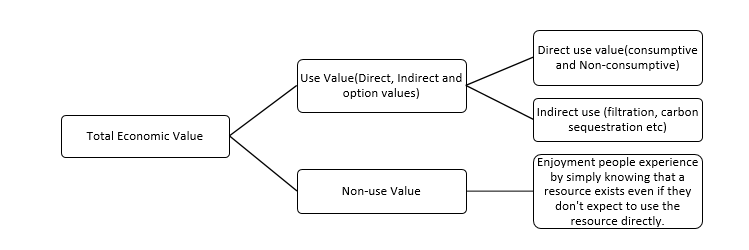
(c) Classify the different ecosystem services using the TEV framework (Figure 16)
Figure 16: The Total Economic Value Framework
Source: Kaggwa, R. 2016 (ibid)
(d) Select appropriate valuation methods and techniques for the ecosystem services identified. The selection of the valuation method is influenced by the availability of data and expertise, among other factors. See Muramira, 2006[3], and Annex 20 for more detail on the Procedure for total economic valuation of forests.
(e) Specify data needed for valuation and identify its sources.
(f) Design and develop instruments for data collection. The instruments for data collection to be used will include an excel template for both data collection and analysis, and a questionnaire for the collection of primary data.
(g) Collect primary and secondary data. Emphasis is put on collection of primary data; secondary data will only be used where primary data is not available. FMPs, inventory reports, ESIA reports, Uganda Bureau of Statistics datasets, and reports of technical studies among others will be some of the key sources of secondary data.
(h) Placing of economic values to each of the quantified ecosystem service identified. Use any of the following approaches
• Cost benefit analysis
• Net present value
• Internal Rate of Return (IRR)
• Any other economic analysis approaches
Instruction 355: The detailed process is found in the draft Guidelines for Valuing Natural Forestry Resources in Uganda by T.E. Muramira[4]. For ease of reference, the text in Annex 20 has been extracted from the draft Guidelines. Forestry practitioners at FMU level should use this Annex and the draft guidelines to develop site specific tools for TEV.
Instruction 356: The detailed process for total economic valuation of forest plantations is contained in NFAs Guidelines for Valuing Plantation Forest Resources in Uganda[5]. FPs shall adapt these guidelines for use in their own plantation management environments
Secretary to the Treasury, Ministry of Finance, 2017. Treasury Instructions (2017) ↩︎
Ronald Kaggwa, 2016. Training Plan for Economic Valuation of Environment and Natural Resources: Phase I (CSOs, DLGs (Political Leadership) – Training Materials prepared for Environment Management for Oil and Gas Sector (EMOS) in Uganda ↩︎
Telly Eugene Muramira, 2006. Guidelines for Valuing Natural Forestry Resources in Uganda – Draft Prepared for the NFA and the Forestry Resources Management and Conservation Programme ↩︎
ibid ↩︎
National Forestry Authority, 2007. Guidelines for Valuing Plantation Forests Resources in Uganda ↩︎