¶ Joint Programming and Planning
The National Planning Authority (Development Plans) Regulations, 2018 provides for joint programming and planning as reflected in its objectives, some of which are listed below:
• Prescribe the procedure for the formulation of harmonized development plans within the decentralized planning institutions;
• Ensure intra and inter Government institutional synergies and linkages in the planning process;
• Facilitate multi-sectoral planning;
• Clarify the institutional framework governing development planning, the key stakeholders and their roles;
• Provide appropriate linkages between national and decentralized institutional budgeting instruments;
• Provide for harmonized planning for projects and programmes;
The joint planning arrangements are based on the national planning requirements and practice guidance for national and district level planning. The Sector Development Planning Guidelines issued by the National Planning Authority require that sectors make adequate consultations with relevant stakeholders including LGs, semi-autonomous institutions, the private sector and civil society organizations during the production of technical papers for submission to the Sector Technical Working Groups for drafting of Sector Development Plans. They also require that the consultation process includes development partners to identify possible areas of support[1].
At the LG level, the Guidelines require that consultations are held with relevant institutions and fora to feed into debates by District Standing Committees which produce technical papers that are consolidated by the District Technical Planning Committees into District Development Plans for submission to the National Planning Authority. District Authorities are enjoined to make adequate consultations with Lower LGs, the private sector, and civil society at that level. The LG Planning Guidelines require LGs to collect data on (Ministry of Finance, 2014[2]):
• The prevailing physical, social and economic characteristics of a LG;
• Sector development situations, focusing on opportunities and potentials for wealth creation and local economic development by each sector;
• The key stakeholders (including private sector, CSO and development partners) situations, opportunities and potentials;
• Crosscutting issues;
• Any other basic data that is essential in informing the formulation of a LG Development Plan strategic direction or its implementation modalities
The Forestry Act, and the Forestry Regulations require active involvement of key stakeholders in preparation of FMPs (Section 28), and DFDPs (Section 8 and Schedule 3). International support arrangements also require full and effective participation of all stakeholders, interest groups and vulnerable and marginalised groups such as forest dependent groups, and/ or other vulnerable and marginalised groups. In Uganda, these requirements have been included throughout all the principles in the NFSS.
There are many stakeholders who will affect, or who will be affected by the forestry programme being planned at varying levels. In order to understand these levels, it is important that the interests and influence of each of these stakeholders are analysed. Figure 17 shows an example of stakeholders identified and mapped. The NFP has elaborated an institutional framework for implementation of forestry programmes. The framework lists a wide range of institutions and their roles and responsibilities in implementing the NFP.
Figure 17: An Example of Stakeholder Identification and Mapping
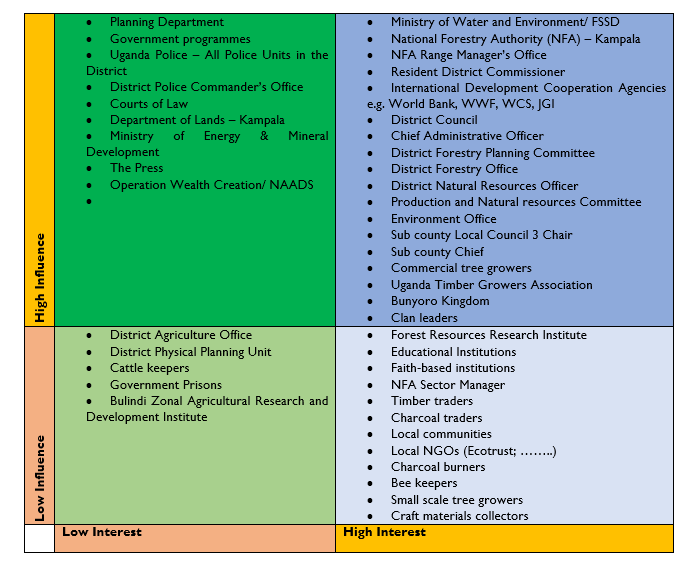
Instruction 358: The FMIs shall identify and engage the key stakeholders in their planning processes in a manner that reaches a high degree of participation. The starting point for stakeholder identification and mapping should be the institutional framework in the NFP.
Instruction 359: FMIs shall apply joint programming and planning requirements in the Guidelines issued by the National Planning Authority during the preparation of their input into the sector strategic plans/ programmes.
Instruction 360: Because NFA and MWE have legal obligations to support LGs and community forestry activities, LGs shall closely involve NFA, FSSD in the preparation of the DFDPs and the annual work plans of the DFOs.