¶ SOCIO-ECONOMIC ENVIRONMENT
¶ 2.1 TOTAL ECONOMIC VALUE OF THE FOREST
Apart from the ecological functions of protection of steep slopes, L. Victoria shores, rivers/ stream banks and wetlands, the Mpanga CFRs provide forest products for subsistence and income generation. The CFRs are also important for climate amelioration which has a bearing on good agricultural production. A rapid total economic valuation (TEV) was undertaken during the preparation of this Plan and the total economic value of the twenty-nine (29) CFRs in the MPA is estimated to be UGX 2.96 trillion (Table 4). The details are shown in Appendix 3.
Table 4: Summary of the TEV

¶ 2.2 POTENTIAL TIMBER AND NON-WOOD SUPPLY
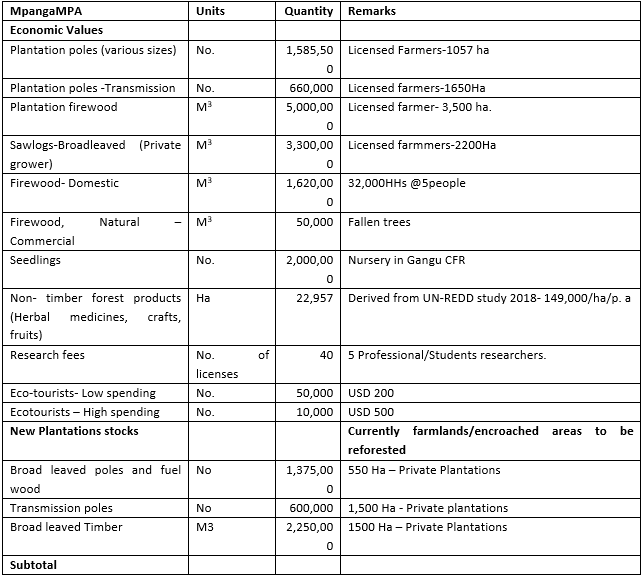
Data derived from forest resource users, assessments and stakeholder consultations indicates the CFRs are major sources of multiple products such as timber, charcoal, firewood, herbal medicine, handcrafts materials, and other forest goods. Table 5 below shows estimated actual and potential quantities and values.
Table 5: Summary of estimated potential quantities of timber and non-wood products
¶ 2.2.1 Timber Supply
While Mpanga (intact), and parts of Gangu, Navugulu, Nakaga, Nakalere, Luwafu, Lukolo and Nawandigi CFRs still have some scattered TMF trees, the rest of the CFRs are currently under Eucalyptus plantations. However, Mpanga CFR is a conservation forest set aside for mainly ecotourism and therefore, the trees therein cannot be harvested for timber. The other TMFs still have immature trees that have either naturally regenerated or have been restored recently. The remaining scattered mature trees in the other TMFs will remain as seed / mother trees.
The mature Eucalyptus trees are being harvested for timber, transmission and building (construction) poles. The practice, for now, is that the trees are felled and cut into logs of specified lengths and ferried to urban centres, including Kampala, where they are converted into timber.
¶ 2.2.2 Non-timber Supply
The non-timber forest products found in these CFRs include transmission and construction poles, firewood, water, craft materials (palm leaves, papyrus reeds, wood for carvings like drums, furniture), mushrooms, edible wild animals, fruits, sand, grass for thatching and mulching, clay for brick making, medicinal herbs, white ants, charcoal, tool handles, pasture and fencing posts. Some of these products are harvested by the forest adjacent communities largely for subsistence purposes. However, firewood is also being sold for commercial purposes especially for brick baking and cooking by schools and other institutions like UPDF.
It is worth noting that crafts materials mainly for drum making is a major commercial business around Mpambire, an upcoming urban centre close to Mpanga CFR. The people interviewed claimed that they had been in this business since time immemorial and vowed to continue doing it in spite of inadequate supply of wood for the purpose coupled with the strict protection measures put in place by NFA to curb illegal harvesting of the same.
In Nsowe CFR, there is rampant commercial charcoal production allegedly by the licensees or their agents who are clearing land for Eucalyptus plantation establishment. There is also grazing in certain parts of the CFR where tree growing hasn’t taken place. Therefore, the grazers are utilising the pasture therein to feed their livestock.
¶ 2.2.3 Ecotourism
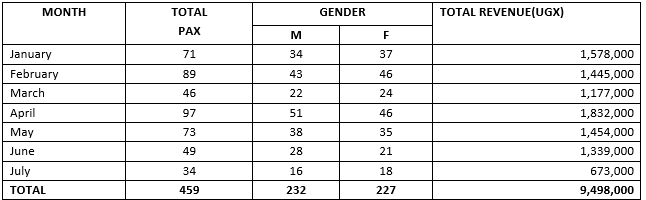
There is on-going Ecotourism in Mpanga CFR under a Public – Private Partnership arrangement between NFA and Global Afrique Safaris. However, the full potential of the site has not been exploited as the number of facilities on the site like bandas, have never been expanded since the take-over of business by the latter. The summary of revenue earned in the period January to July 2021 is shown in Table 6. Nevertheless, accommodation and other necessary facilities are inadequate given the fact the site is located near major urban centres and on the highway on one of the major tourism circuits to national parks in western and south western axis of the country. This would make it a good stop over and resting point either as tourists go to or return from that side.
The site has been connected to the national grid of hydro - electric power though it has the common challenge of being unreliable and the tariff being high. The road to the site however, is in poor condition making it hard for clients that don’t have 4WD vehicles to reach the place. The solar panels in place have a low voltage to run many appliances.
On the other hand, some CFRs still with natural TMFs such as Nakaga, Lukolo and Luwafu have potential for ecotourism if well harnessed due to their close location to Lake Victoria. Both the latter CFRs touch the lake and have sufficient sandy shore lines that are suitable for beach establishment for various recreation activities. This would entail other aspects of tourism such as cultural and agro tourism among other attractions in the surrounding villages.
However, a recent study on the potential for ecotourism in the sector ruled out Lukolo due to the large deposits of sand in it. The study instead recommended Nakaga because of the natural forest strip left and its proximity to the main Kampala – Masaka Highway.
Table 6: Tourists Records at Mpanga Ecotourism Site for the Period from January to July 2021
Source: NFA
¶ 2.3 MARKETS, GROWTH STATISTICS AND YIELD
¶ 2.3.1 Markets
There are lucrative markets for timber, transmission and construction poles; and firewood for both domestic, commercial and industrial purposes in the existing urban and the mushrooming urban centres such as; Kampala, Kyengera, Entebbe, Wakiso, Mpigi, Buwama, Kabasanda, Maddu, Kibbibi and Gombe etc. With the ever-increasing population, the demand for fuelwood, timber, poles and bricks for construction is bound to continue increasing.
Again, with the government promoting the program of rural electrification, the demand for transmission poles is also bound to grow in spite of the introduction of concrete poles for transmission. Therefore, any investments in these products are projected to be profitable.
Similarly, with tourism in Uganda and the region at large growing at a fast rate (save for the interruption by COVID 19 pandemic), this is hoped to provide market for the crafts produced in the MPA. Generally, Uganda being a culturally rich country and Buganda in particular holding strong cultural beliefs, the market for most of the crafts and herbal medicines is assured.
As the country is steadily moving towards a middle-income status, it is hoped that the demand by the affluent urban dwellers to spend some of their time and money on leisure and recreation will correspondingly increase and this will definitely provide market for the existing and proposed Eco-sites in the MPA especially given their proximity to most urban areas within central Uganda.
Local communities take large quantities of non-wood forest produce like herbal medicine, honey, mushrooms and fibres that are important to the livelihoods of rural communities. The high rate of debarking of Spathodea campanulata trees in the sector is enough evidence that there is high market for herbal medicine either locally or nationally as it is alleged that some of this medicine finds its way to other towns including Kampala.
The Table 7 below shows the population figures for the 2014 census and projected figures up to 2021 for the districts where the CFRs in the MPA are situated. Part of this population is anticipated to provide market for the forest products and services produced in therein.
Table 7: Population of the surrounding area within the MPA
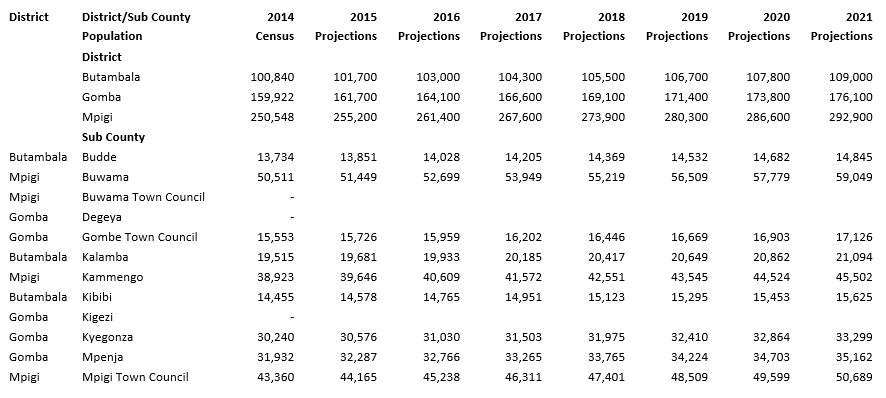
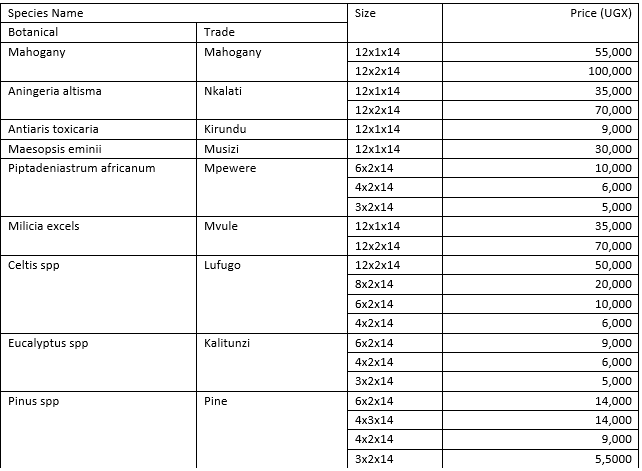
Table 8: Timber prices of selected tree species around Lakeshore Markets as by July, 2021
Source: NFA Utilization Unit
Growth Statistics and Yield
In order to monitor growth rates and yield of both the natural forests and the plantations to be established, there will be need to establish permanent sample plots (PSPs) in Nawandigi and Navugulu.
According to the yield model of Eucalyptus grandis in Uganda developed by Denis Alder (2003), the CFRs in the MPA fall in site index 30-34 which is determined by their climatic and soil factors. Based on this model, the growth statistics and yield for Eucalyptus grandis are shown in Figure 1 below, assuming a site index of 34, spacing of 3x3m, a survival rate of 70% and the management standards of 70%.
However, there has been a major shift, by most private tree growers in the MPA, from Eucalyptus grandis to clonal eucalyptus largely GU and GC due to their faster growth.
From the Figure 1 below, based on the above assumptions, at year 5 for example, the expected yield is 157M3 /ha. At year 10, the yield is expected to be 280M3/ha assuming 25% thinning is done at year 4 and 8 respectively.
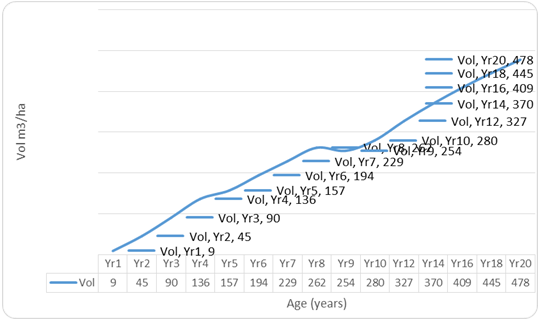
Figure 1: Growth Statistics and yield
As for the natural forests, no recent inventories have been carried out probably because of the degraded nature of the forest. However, there is need to carry out diagnostic sampling in each of them for monitoring the growth and recruitment of the trees in these CFRs.
¶ 2.4 PARTNERSHIPS AND STAKEHOLDERS
¶ 2.4.1 Partnerships
Partnership is an agreement to cooperate in order to advance the partners’ mutual interests, mobilising their strengths and resources in a transparent and equitable manner. It avails opportunity to solve complex problems that no single institution can resolve with less resources spent. It is also a process of availing opportunities for interested people to be heard or influence decisions that affect them.
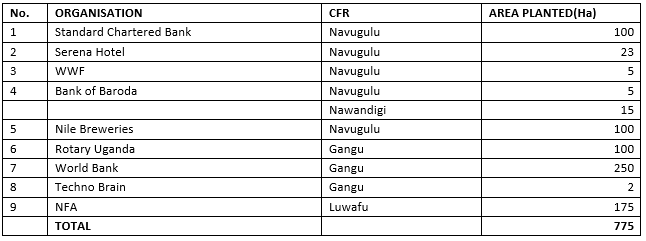
National Forestry Authority (NFA) has partnered with private companies to restore some of the degraded natural forests in the sector with indigenous tree species using the mixed species approach. The species planted include: Maesopsis eminii, Cordia millenii, Terminalia spp, Mahogany, Albizia spp, Cedrella odorata, Markhamia lutea, Polyscias fulva, Prunus africana, Batdavya nyasica and Ficus spp. The area restored by each partner is shown in Table 9.
Table 9: Area of CFR Planted by each Partner for Restoration of Degraded Forests
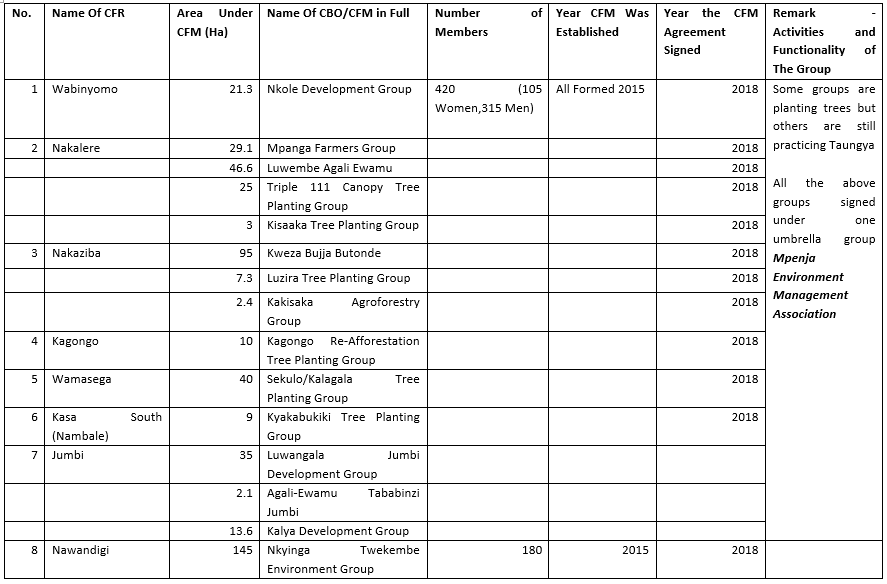
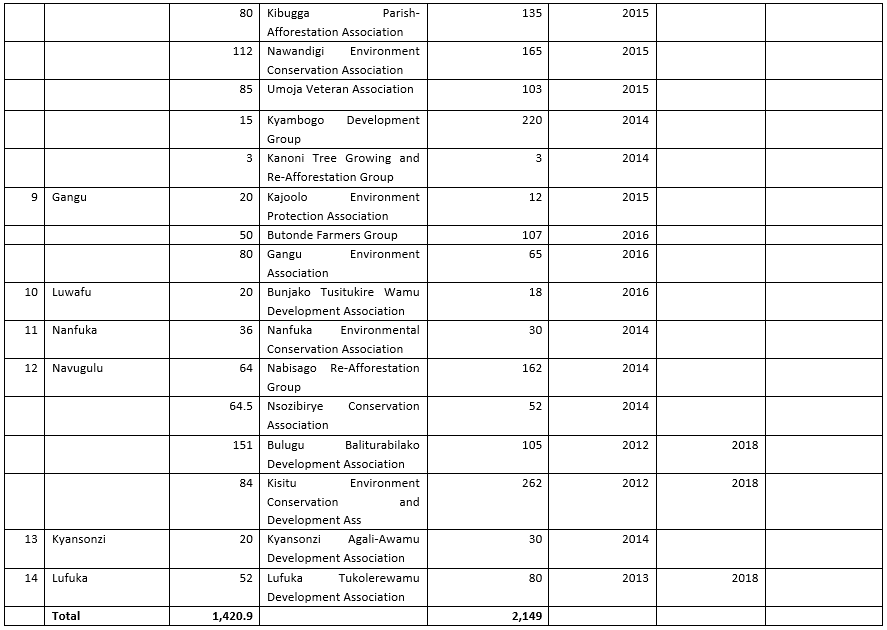
There is also Collaborative Forest Management (CFM) in 14 CFRs with a total membership of 2,149 people. A total of 1,420.9 ha have been planted under the CFM arrangement consisting of both Eucalyptus and indigenous trees. Table 10 gives the details of CFM in the MPA.
Table 10: CFM Groups in Mpanga MPA as of 31st July 2021
In addition, NFA has entered into a Public – Private Partnership (PPP) arrangement with Global Afrique Safaris to manage Mpanga Ecotourism site. The licensing of private tree growers to participate in increasing the forest base through the establishment of eucalyptus plantations is another form of partnership.
The involvement of the Environmental Protection Force in supporting NFA in the fight against illegalities in the sector is yet another form of partnership between NFA and security forces i.e. Uganda Police Force (UPF) and Uganda Peoples Defence Forces (UPDF).
¶ 2.4.2 Stakeholders
There are many stakeholders who will affect or will be affected by this FMP. Each of them affects, or is affected by the FMP at a level that may be different from some of the others. In order to understand these levels, their interests and influence were analysed as shown in Figure 2 below.
The stakeholders are of varying interests and influences. Local community interests are largely in the supply of forest products and services while government agencies look at developmental and other aspects that affect the nation as a whole. Key stakeholders include institutions like NFA, National Environment Management Authority (NEMA), Ministry of Water and Environment (MWE), Ministry of Energy and Mineral Development (MEMD), Mpigi, Butambala and Gomba District Local Governments and the local communities. The private tree growers are also key stakeholders. UPDF Marine Force – Fisheries Protection Unit (UPDFMF-FPU) has established a barracks in Luwafu CFR though it was not done according to the conditions prescribed in the National Forestry and Tree Planting Act (NFTPA) of 2003.
In order to understand the influence and interests of the various stakeholders in the analysis, the broad categories of some of the stakeholders were broken down to relevant user groups, offices or officers.
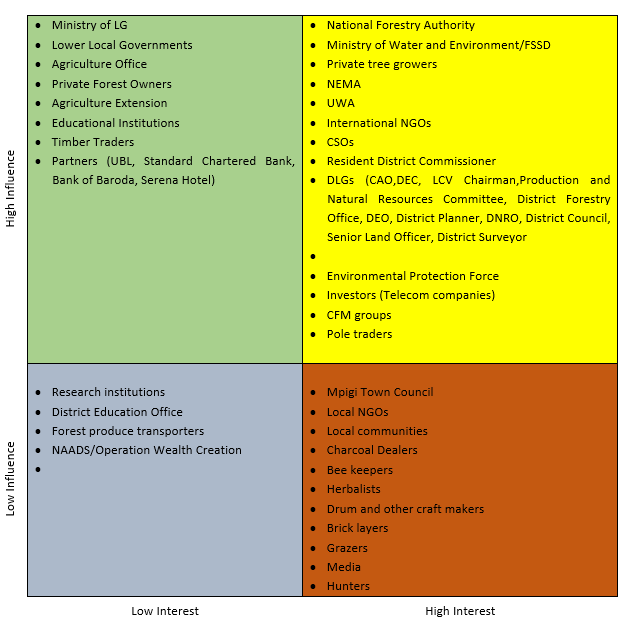
Figure 2: Stakeholder Influence and Interest
From the above analysis one deduces that in order to successfully mobilise resources and support for implementation of this FMP, the category in the yellow box (high interest and high influence) is core in determining the direction of forestry management in the MPA, including approval of the FMP, resource mobilization, priority setting and actual implementation of forestry activities.
Those in the brown segment are critical in actual implementation once resources are available. Those in the green segment (high influence – low interest) need tactful approaches to stimulate their interest so that they can support forestry development. Those in the blue box (low interest – low influence) require awareness creation, advocacy and/or lobbying aimed at stimulating their interest to participate in forestry development.
2.4.3 Roles and Responsibilities of Partners and Stakeholders
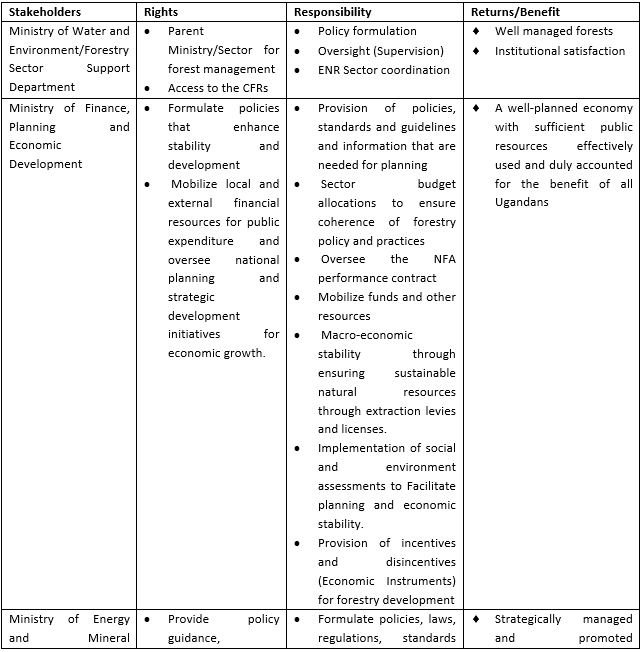
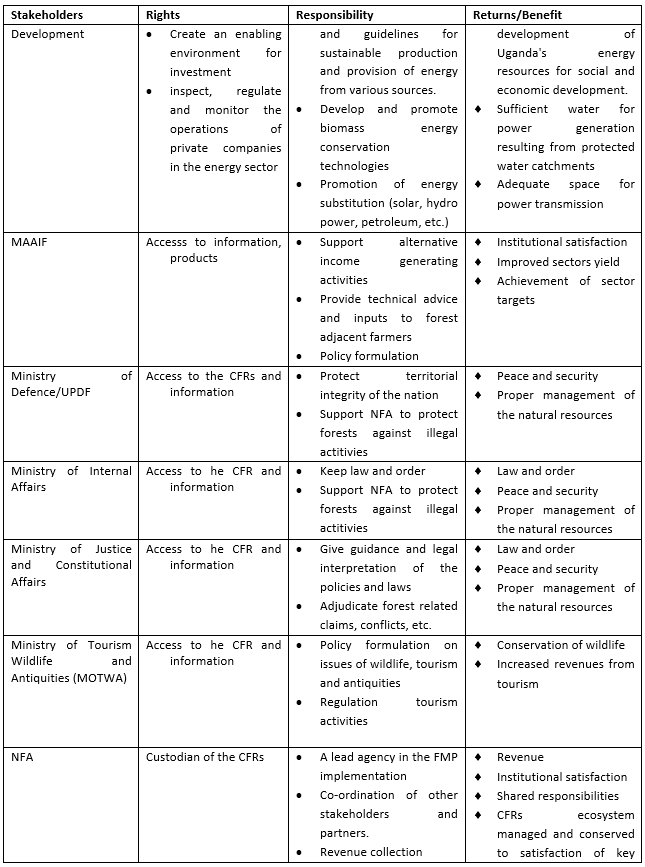
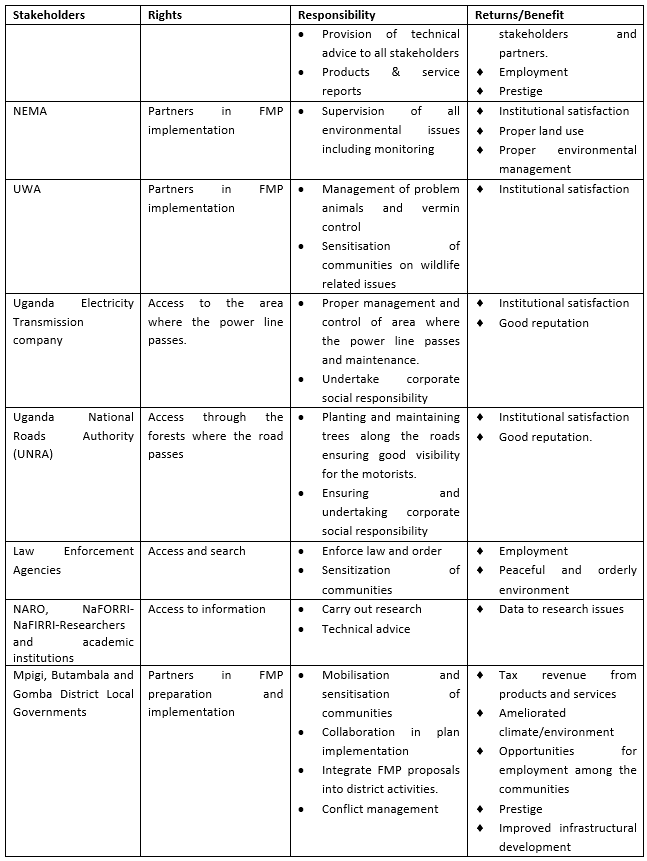
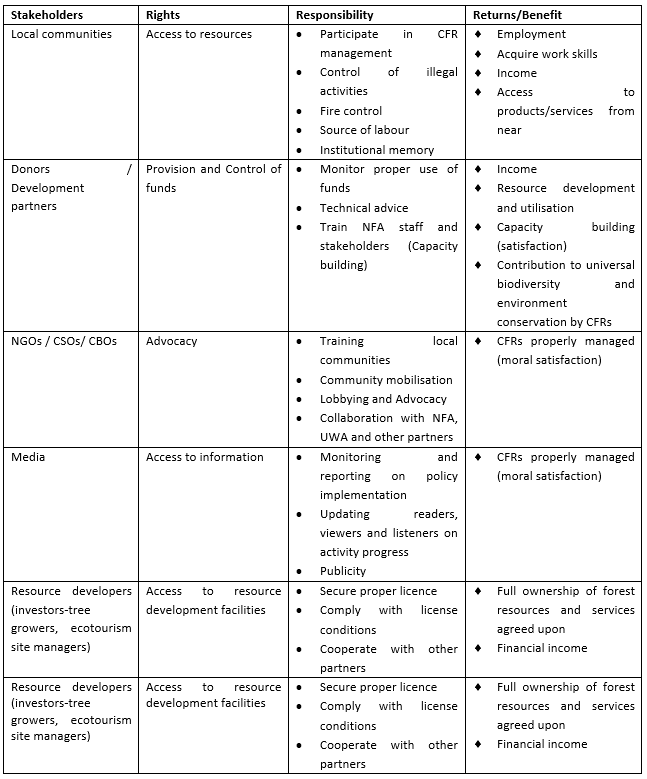
The rights, roles/responsibilities and returns of the various stakeholders in the MPA are shown in the Table 11 below.
Table 11: Rights, Responsibilities and Returns of the Stakeholders in the MPA
¶ 2.5 THREATS AND CONFLICTS
¶ 2.5.1 Threats
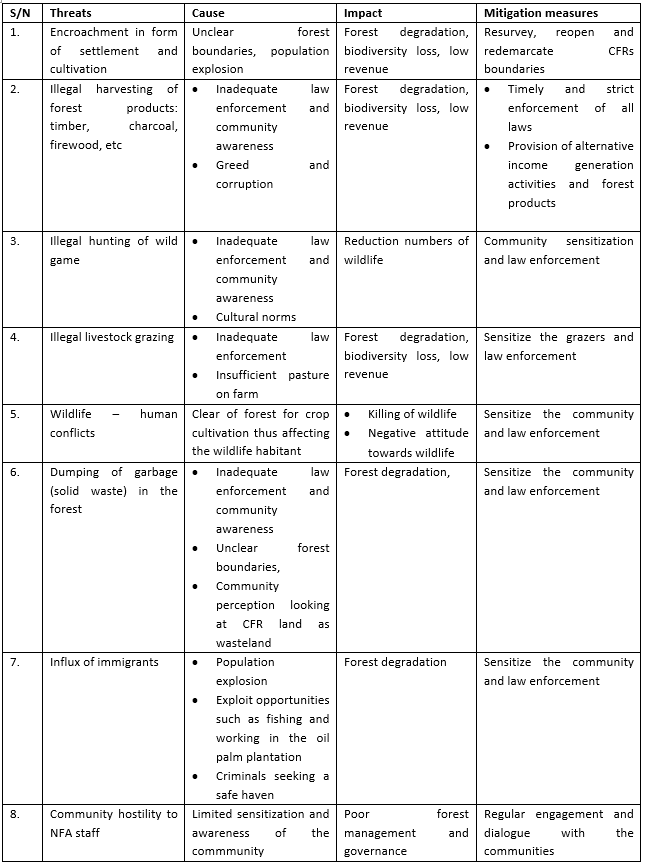
The CFRs in the MPA have undergone and are still under immense pressure for forest products due to their proximity to major urban centres. Consequently, there are many illegal activities in most of them though they vary in type, extent and intensity. The major threats are: - illegal charcoal production, encroachment for agriculture and settlement, brick making, sand mining, grazing, timber harvesting, unclear forest boundaries, community hostility to NFA staff etc.
In Nsowe CFR in particular, whereas the forest land has been allocated to private tree growers, there are a lot of illegal activities such as human settlements, charcoal production, agricultural cultivation, construction of public infrastructure like churches, schools, and health centres III and IV and a government prison. By the time of preparing this Plan, there was a court case between NFA and illegal settlers especially the grazers.
Whereas in Kalombi CFR, it was alleged that a big chunk of CFR land had been surveyed and taken over by a private individual who has established a home and farm on the said land. He also carved out part of a private tree grower’s plantation, a one, Mr Isingoma Godfrey.
The high rate of urbanisation poses a threat to the peri-urban reserves especially Mpanga, Navugulu. A comprehensive list of threats, issues and concerns in the MPA are given in Table 12.
Table 12: Main Threats in Mpanga MPA

¶ 2.5.2 Conflicts
(a) Enforcement of legislation
The main conflict is between NFA and local communities. This conflict arises out of the responsibility of NFA to enforce the National Forestry and Tree Planting Act, while local communities do not want any legal restrictions to have access and use of the CFRs. This is very conspicuous in Kagongo CFR where the local communities have encroached in the forest both for settlement and crop cultivation.
This has caused hostility between the communities and NFA. There are similar cases in especially the CFRs that are still tropical moist forests and those with unclear boundary issues, with differing nature, extents and intensity of encroachment and conflicts.
(b) Human – Wildlife Conflicts
The natural forests are a habitat to animals like duikers, monkeys, snakes and these rely on the forests for food. The clearing of the natural forests has created a reduction of food for the animals leading to some of these animals invading farmland in search of the same. The CFRs where this is common include, Kyansozi, Navugulu, Luwafu, Nawandigi, Gangu, Mpanga, Lukolo and Kabuye.
(c) Local community-private tree growers’ conflict
Denial of access and use rights to the communities by the private tree growers for the products and services like firewood, mushrooms that the communities were getting from the natural forests is a spark for conflict.
(d) Intra- community conflicts
In scenarios where there are different user groups e.g. grazers, tree growers and crop cultivators, each with varying interests, conflicts arise for example when the livestock trample the trees of the tree growers. Similarly, during times of scarcity of water such as dry season, there is a scramble for water between the subsistence water users and the cattle grazers. The resultant conflicts interfere with the proper management of the CFR and have got potential to interfere with the implementation of this management plan.
¶ 2.6 COMMUNITY USE OF FOREST PRODUCTS
The CFRs are important sources of fuelwood and poles, water for domestic and commercial use (especially for brick making and bread baking) and for watering domestic animals. There are numerous protected wells and other water points in some CFRs in the sector such as Degeya, Kyansonzi, Nawawandigi, Lufuka, Kagongo, Nakaziba, Gangu, Mpanga, Wamasega, Navugulu, Kabuye and Kalandazi.
The other products obtained from the CFRs are grass for thatching and mulching, craft materials (wood for making drums and local stools, papyrus, palm leaves etc.), medicinal herbs, mushrooms, fibres and honey.
Communities living around Mpanga CFR, particularly in Mpambire parish, specialize in making crafts such as drums, baskets, traditional stools, mortars and pestles among others.
The people interviewed during the stakeholder consultations confessed that people in this area have been into this business since time immemorial, and vowed to continue in the same trade in spite of the ever-dwindling raw materials and strict surveillance of the forest by NFA staff. Trade in crafts is thriving due to the ready market provided by the people using the main Kampala- Mbarara road including tourists.
Whereas crop cultivation in the CFRs is illegal, there is conspicuous community use of forest land for growing of mainly vegetables, maize, beans, rice and yams in the wetland patches of most CFRs. This is perpetuated by the managers of the licensed tree growers.
Brick making is prominent in Lufuka CFR. On the other hand, sand mining was gaining much ground in some CFRs such Lukolo, Lufuka and Kalandazi but has been stemmed of recent.
The forest adjacent communities also use the reserves for livestock grazing especially goats, sheep and cattle. In almost all the CFRs, there is marginal grazing along the forest boundaries though in Nsowe CFR, cattle grazing seemed to have been the main activity however, as the licensed tree growers continue to expand the planting of their allocated areas, with some fencing off the planted areas, the grazers seem to be slowly getting edged out.
With many of the natural tropical high forest CFRs turned into Eucalyptus plantations mainly, many community members get employment by providing labour to carry out most of the forest operations such as land clearing, planting and weeding.
¶ 2.7 ROAD INFRASTRUCTURE
The major management infrastructure covers transport and buildings. Transport is mainly by road to access the CFRs.
¶ 2.7.1 NFA Roads
Currently there are no roads in these CFRs that are managed by NFA save for the 700m access road to Mpanga Eco-tourism site.
¶ 2.7.2 Public Roads
The CFRs are accessed through public feeder roads and community roads. The Kampala – Masaka high way passes close to Mpanga, Kyansonzi, Kalandazi, Nawandigi and Gangu CFRs. Buwa CFR is also near this high way. On the other hand, the Mpigi-Butambala-Maddu highway passes near Navugulu, Kagongo and Nawandigi CFRs. Generally, all the CFRs are easily accessible through the Local Government or UNRA maintained roads.
¶ 2.7.3 Buildings
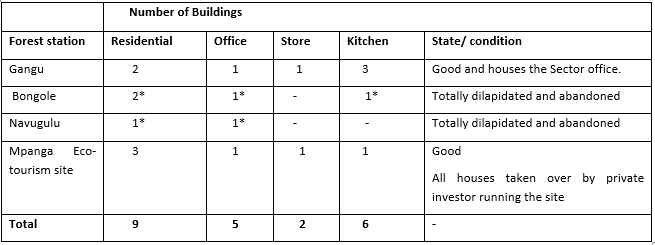
There are only two stations in the sector that have good houses for staff accommodation or office space. These include; Gangu and Mpanga Eco-site though the NFA staff now don’t stay in the houses in the latter, as the private investor managing the site has taken over all the houses for accommodation of either their staff or tourists. The rest of the old stations have been totally abandoned due to their total dilapidation as detailed in Table 13.
Table 13: Location and Type of Buildings in Mpanga Sector
Houses no longer habitable and abandoned
¶ 2.8 STAFF AND LABOUR
¶ 2.8.1 Staff
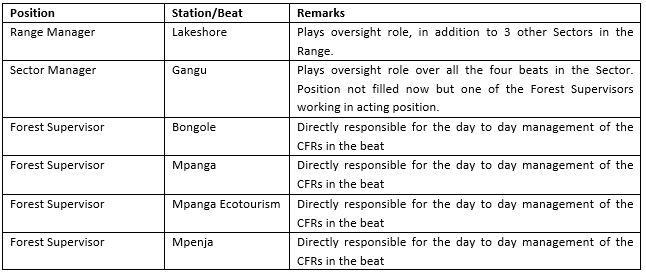
Mpanga MPA (sector) has 5 employed staff, Table 14. They include one (1) Sector Manager and four (4) Forest Supervisors. Each Forest Supervisor is in charge of a beat with a specific number of CFRs to protect and manage.
Table 14: Staffing in Mpanga MPA (Sector) – as of June 2021
The four beats in the sector are shown in the Table 15 below;
Table 15: Names of Beats and the Respective CFRs in each Beat.
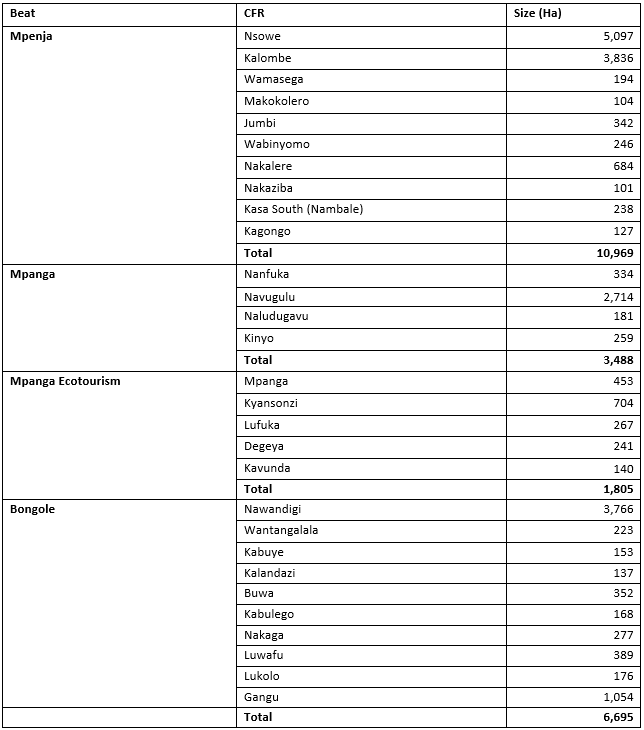
Table 16 shows the number of staff, rank and wage.
Table 16: Mpanga Sector staff position

¶ 2.8.2 Labour
Most of the labour in the MPA is contracted. These include forest patrolmen, compound and trail maintenance workers. These personnel are organized under Mpanga Conservation Association, which is a community-based organization contracted to do the work described above.
Each patrolman is paid UGX 100,000 per month, though there are complaints of perpetual delay in payments.
The Tour guides, Eco-tourism caretaker, security guards and other workers in the Ecotourism site are now managed by the private investor that has been licensed to manage the site.
Locally, individuals are normally contracted to do forestry work such as handling impounded produce, boundary maintenance and re-opening, encroachment, enrichment and restoration planting. The average man-day is between UGX 5,000 - 10,000 depending on distance from Mpigi town or any other urban area. The pay is higher in villages around Mpigi town compared to others far from town.
¶ 2.9 REVENUE AND EXPENDITURE
¶ 2.9.1 Revenue
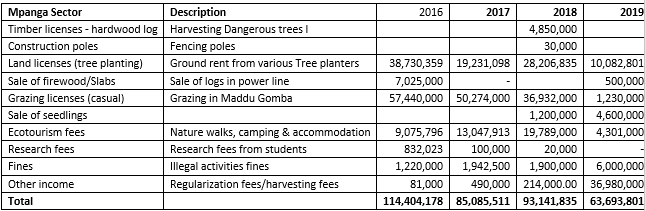
The revenue collected in the sector in the last three years (2016-2020) was UGX 106,461,509 as detailed in the Table 17.
Table 17: Revenue in Mpanga Sector for the period 2016-2020
Source: NFA Finance Directorate
¶ 2.9.2 Expenditure
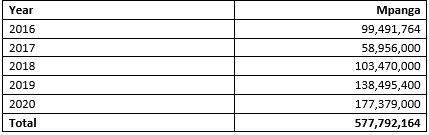
The total expenditure in the MPA for the last four years (2016-2020) was UGX 577,792,164 as detailed in Table 18.
Table 18: Expenditure for Mpanga MPA for the Period 2016 – 2020
Source: NFA Finance Directorate