¶ CHAPTER 2: SOCIO-ECONOMIC ENVIRONMENT
¶ 2.1 Total Economic Value of the Forest
The CFRs in the Matiri MPA provide benefits ranging from direct and indirect use values, option and existence values. The CFRs provide variety of forest products; perform ecological functions of protecting steep slopes, stream banks and wetlands, climate moderation, carbon sequestration and hold unspecified potential for future use and non-use values.
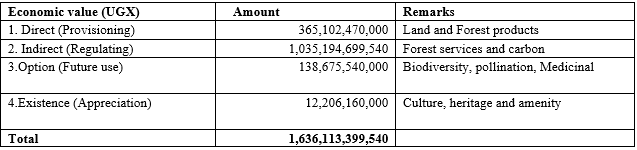
However currently there is no established data to guide the determination of the monetary values of most of the regulatory services of the forest as more research studies are needed. Total economic value (TEV) of the six (6) CFRs in the MPA has been estimated to be UGX 1,636,113,399,540= as summarized in the Table 5 below. Appendix 4 shows details of the TEVs for CFRs in the MPA.
Table 5: Summary of TEV Values
¶ 2.2 Potential Timber and Non-Wood Supply
¶ 2.2.1 Timber Supply
There has been no Exploratory Inventory (EI) done in the MPA to provide the important management data for determining the timber potential. The CFRs are classified as young and colonizing tropical high forests and woodlands which do not currently have sufficient merchantable trees for commercial timber exploitation. The forests given good management will be able to produce 1m3 /ha timber in the next 30 years which is not within the period of this plan.
Never the less the rapid assessment of timber species in Matiri, Kitechura and Ibambaro indicates availability of medium value timber species like Funtumia elastica, Antiaris toxicaria, Markhamia lutea, Albizzia spp,Cordia millenii, Fagara spp and others. There are still sufficient number of seed trees of the above timber species which provide the seed needed for natural regeneration.
Rwensambya and Buhingiro CFRs are severely degraded and have no timber value currently. The main timber supply will be from 120 Ha of Eucalyptus plantation by licensed private grower in Buhingiro CFR and trees still on private land.
¶ 2.2.2 Non-timber Supply
There is currently limited documented data on supply and demand of non- timber forest products available. The non-timber products in these CFRs include firewood, poles, water, mushrooms, honey, wild meat, palm leaves and fibres for craft making, fruits, thatch grass, sand, clay and medicinal herbs. These are collected by the local communities largely for subsistence purposes. However, firewood is also being sold for commercial purposes, especially for brickmaking and cooking by schools and other institutions.
In the woodland areas illegal commercial charcoal burning by local people targets high calorific value tree species including Terminalia, Albizia and Combretum species for income generation. There is also potential for bee keeping since a lot of bee forage can be obtained from the natural forest forage in the CFRs. The per capita consumption of firewood is estimated to be 1 M3valued at UGX20, 000. The estimated value of NTFPs is 149,000/ ha (UN-REDD, 2018)
There is potential for growing of Prunus africana in Matiri CFR and indeed in community areas (ex-situ) around the forest for the medicinal bark used in the treatment of prostate cancer. This can be one enterprise that communities can be encouraged to do since Prunus bark is highly marketable product internationally. One investor Cudwell (U) Ltd planted Prunus africana in Matiri CFR but maintenance was not done well.
¶ 2.2.3 Ecotourism
Matiri, CFR lies on the Western Tourist Axis of Fort Portal Tourism City and Queen Elizabeth National Park and has potential as stop over for nature based tourism including nature walks, bird viewing, camping and research. This requires identifying the attractions and investing in tourist facilities in partnership with the private sector and marketing the site in partnership with Uganda Tourism Board (UTB).
Mr Namanya Balamu was in 2018 licensed to develop stop over for Tourists in Matiri CFR. However, the concessionaire has not started any development but the site was demarcated. This is the enterprise that can raise the value of Matiri CFR, and surrounding CFRs and generate revenue especially in absence of timber and other commercial products.; therefore should be taken seriously. The nature based tourism can be integrated with community tourism involving the local communities into activities like providing food, handicrafts, entertainment and village walks.
¶ 2.3 Markets, Growth Statistics and Yield
¶ 2.3.1 Markets
The CFRs in Matiri MPA are proximate to the large urban populations in Fort Portal and Kyenjojo and Mubende which provide ready market for forest products. There are also a number of fast growing urban centres especially along the Fort Portal-Kyenjojo-Mubende highway (such as Nabigongola and Kakabara) that increase the demand for forest products within the MPA.
The CFRs have been managed mainly for nature conservation. Currently, therefore, there is no licensed commercial production of timber and any other forest product in any of the 6 CFRs in this MPA. However, the demand for charcoal and firewood is growing and the supply is not sustainable. There are currently no statistics of the quantities of various products illegally extracted from the CFRs for the urban markets.
¶ 2.3.2 Growth Statistics and Yield
There has been no Exploratory Inventory (EI) of the Matiri FMA CFRs to establish the available standing stocks. EI provides information on available standing stocks including species, size classes, quantity and quality of the crop and distribution within the forest including also the recruitment potential. There are currently no production zones demarcated in the large forests of Matiri Kitechura and Ibambaro due to lack of guiding information.
These forests will not produce commercial timber quantities in this plan period. However tropical high forests in Uganda have an annual timber increment of about 1 M3 /ha /annum to give sustainable yield of 30 M3/Ha of timber round wood on 30 year felling circle. 120 Ha of broad leaved plantations in Buhingiro CFR managed for timber will produce timber during this plan period of about 300 M3 /Ha at the age of 12 years given the good growth conditions for Eucalyptus in this area.
¶ 2.4 Partnerships and Stakeholders
¶ 2.4.1 Partnerships
The key partners for the FMA include the DLGs of Kyenjojo and Kyegegwa the Private Sector involved in development of commercial forest plantations, NGOs, CBOs and the community’s surrounding the forests. The Local governments support NFA in law enforcement and governance. The private sector has established 120 Ha of plantations in Buhingiro CFR, and CFM communities have planted woodlots in Rwensambya, and Kitechura CFRs.
Local communities participate in the management of CFRs by helping to curb illegal activities but also benefit through tree planting in the CFR land allocated by NFA. CFM is being implemented in the CFRs of Matiri, Rwensambya and Kitechura each with one group of CFM. Non-governmental organizations (NGOs) and community-based organizations (CBOs) have promoted forest conservation among the people and supported community development initiatives. JESE a local NGO has been working in the sector to support community development initiatives in Matiri CFR.
UNHCR has supported restoration of 100 Ha in Rwensambya CFR and another 100 Ha will be done under Danish Refugee Council .and 50 Ha has been reserved for CFM planting. Uganda Tourism Board (UTB) will be essential for promotion of Ecotourism activities in the Matiri MPA.
¶ 2.4.2 Stakeholders
Key stakeholders for NFA include Ministry of Water and Environment (MWE), NEMA, UWA, Kyenjojo and Kyegegwa DLGs; Kyenjojo Town Council, NGOs and the local communities. These stakeholders will affect or will be affected by this FMP in different ways and levels.
Local community have high interest but with low influence in the management of the FMA especially the access to forest products and services. The government institutions on the other hand have high influence and interest in the sustainable management of the CFRs. The interests and influence of various stakeholders are analysed in Figure 1 below.
Figure 1: Stakeholder Influence and Interests
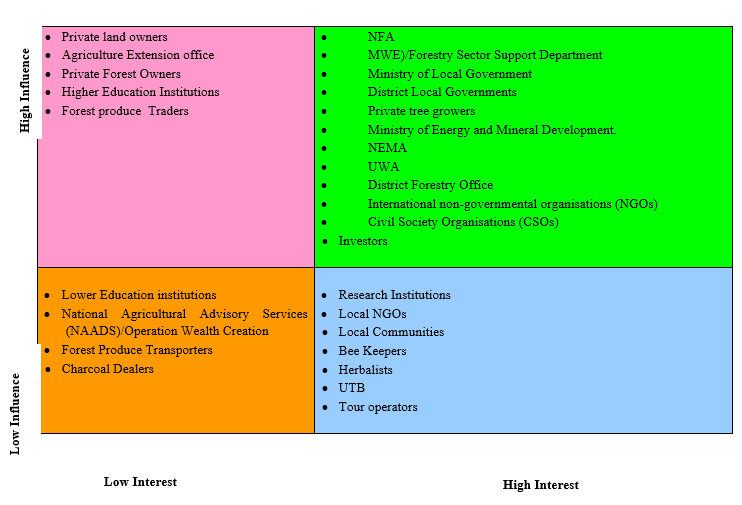
The above analysis leads one to deduce that in order to successfully mobilise resources and support for implementation of this FMP, the category in the green box (high interest and high influence) is core in determining the direction of forestry management in the MPA, including approval of the FMP, resource mobilisation, priority setting and actual implementation of forestry activities. Those in the blue segment are critical in actual implementation once resources are available. Those in the pink segment (high influence – low interest) need tactful approaches to stimulate their interest so that they can support forestry development. Those in the brown box (low interest – low influence) require awareness creation, advocacy and/or lobbying aimed at stimulating their interest to participate in forestry development.
¶ 2.4.3 Roles and Responsibilities of Partners and Stakeholders
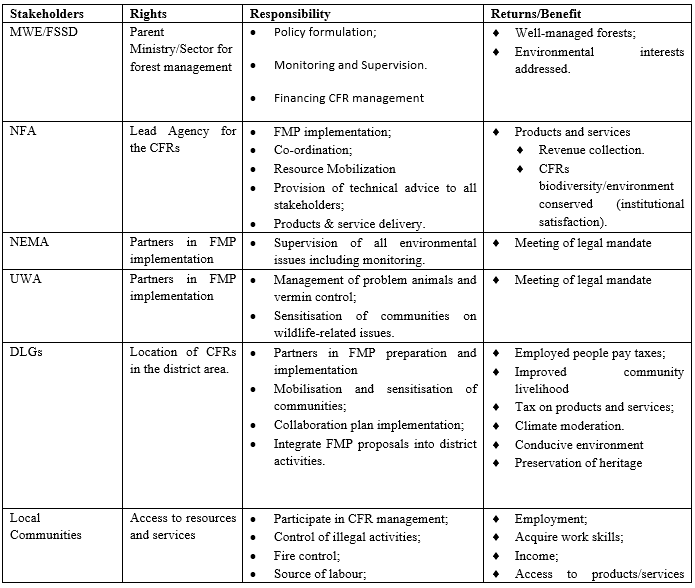
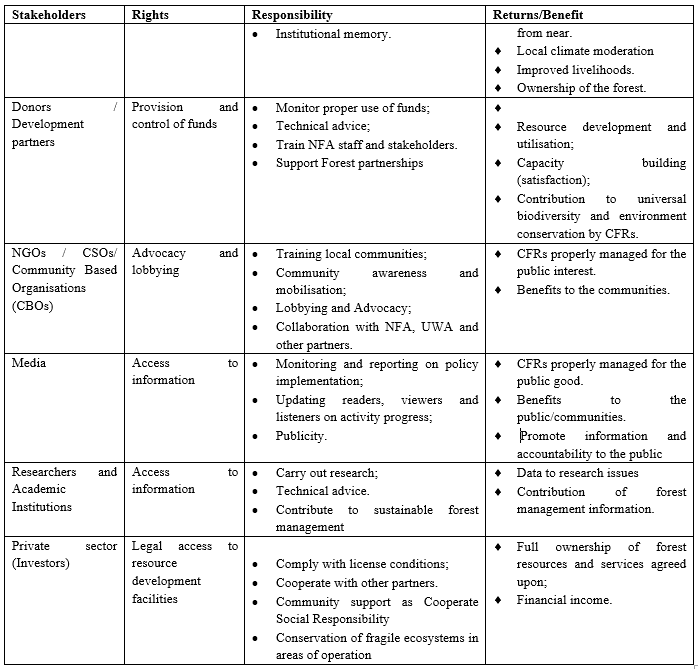
The following partners and stakeholders (Table 6) have roles and responsibilities in the MPA.
Table 6: Roles and Responsibilities of Partners and stakeholders.
¶ 2.5 Threats and Conflicts
¶ 2.5.1 Threats
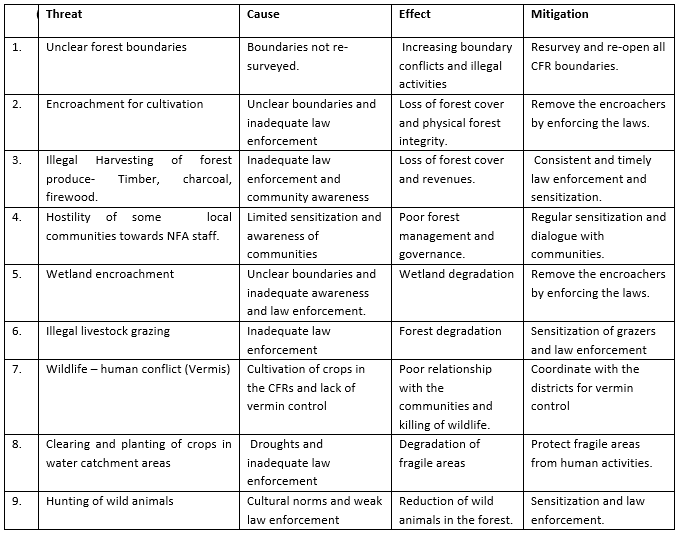
The main threats to the CFRs are encroachment, illegal harvesting of charcoal; claims of ownership of land especially in Matiri and Buhingiro CFRs where there are illegal land titles and court cases. The external boundaries of Kitechura, Ibambaro,Nkera, Buhingiro, Rwensambya and the Kyankaramata portion of Matiri , are not clear resulting in encroachment and boundary conflicts.
There is a lot of degradation on Rwensambya CFR by the refugees in Kyaka refugee settlement who carry out illegal cultivation and charcoal burning. Never the less the level of threats to these CFRs can be managed through strengthening partnerships with the districts, communities and CSOs and improving the law enforcement mechanisms.
Table 7: Threats Identified
(b) Enforcement of legislation
The existing conflicts are in Matiri, and Buhingiro CFRs where there are conflicts related to court cases against NFA over land ownership. Other conflicts relate to restricted access to the CFRs for forest products and cultivation. These conflicts arise out of the responsibility of NFA to enforce the National Forestry and Tree Planting Act, 2003, while local communities do not want any legal restrictions on access and use of the forest reserves.
(c) Human – Wildlife Conflict
The natural forests of Matiri, Ibamabaro and Kitechura have wild animals (vermin) especially baboons, bush pigs and monkeys that are destructive to crops of the surrounding communities. The communities are ignorant of the role of the districts in controlling Vermin and have been practising control hunting the animals themselves.
¶ 2.6 Community use of forest products
The National Forestry and Tree Planting Act, 2003 provides for community use of forest reserves directly as a right but also through partnerships or licenses. This includes access to forest products like timber, fuel wood and poles, water and non – timber forest products including water, grass for thatching and mulching, fodder, craft materials (papyrus, palm leaves etc.), medicinal herbs, mushrooms, fibres, wild meat and honey.
Through collaborative forest management arrangement communities can access 5% of the CFR land for tree planting free of charge. This is currently being piloted in the CFRs of Matiri and Rwensambya and Kitechura under CFM arrangement.
¶ 2.6.1 Gender and Equity
The roles of women and men in the use and management of forests is emphasized in good forest governance practice. Women are involved mainly in the collection of livelihood products from the forest including firewood, water, mushrooms, fibres and handicraft materials. Men and youth on the other hand access products for commercial purposes including firewood, charcoal, timber and wild meat.
In terms of roles towards forest management, the participation of men is more pronounced in activities like forest restoration, protection and boundary work while women work in the nursery and tree planting and weeding contracts. The initiation of CFM activities in Matiri, Kitechura and Rwensambya has facilitated the increased participation of women and youth in activities like tree planting (woodlots) for poles and firewood.
There is need to encourage more women to participate actively in forestry programmes and access more benefits from forest management through affirmative action like skills training, award of forest contracts among others. The support of the Community Development office in the districts will be required for equitable mobilization of the different gender and social groups.
¶ 2.7 Infrastructure
¶ 2.7.1 NFA Roads and buildings
Currently there are no roads in these CFRs that are managed by NFA. There are no NFA field management buildings for both office and accommodation. However, there is a suitable site in Matiri area planned for a Forest station which has good panoramic view of Matiri CFR and some foundations had been laid during Forest Department but the construction was halted to date.
¶ 2.7.2 Public Roads
A network of roads maintained by UNRA and local governments connects all the CFR. This provides easy access to the CFRs. Some roads are in good condition but others managed under the district are really difficult to use especially during the wet season.
¶ 2.8 Staff and Labour
¶ 2.8.1 Staff
The staff in the sector comprise the Sector Manager and two Forest Supervisors as shown in the tab shown in Table 8 below.
Table 8: Staffing in Matiri MPA
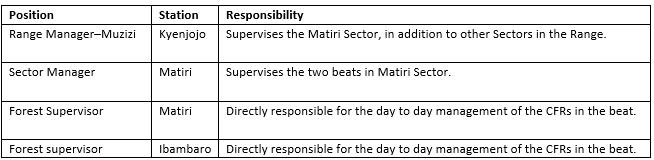
The staff is inadequate considering the area and threats facing the CFRs that are widely spaced in the MPA. The current staff salary is about UGX 62 million per annum.
¶ 2.8.2 Labour
Labour in the MPA is readily available, though most of it is unskilled and costs between UGX 5,000 -10,000 per workday depending on the task. Most of the forest fieldwork is executed using locally contracted groups or individuals.
The Forest Supervisor is assisted by forest patrolmen who are based in areas near the CFRs. Each patrolman is assigned a CFR or a group of CFRs to patrol. There were 12 patrolmen in the MPA at the time of preparing this FMP which number is inadequate for overcoming the challenges in the CFRs. The patrolmen are poorly motivated and may therefore be influenced by illegal operators.
¶ 2.9 Revenue and Expenditure
¶ 2.9.1 Revenue
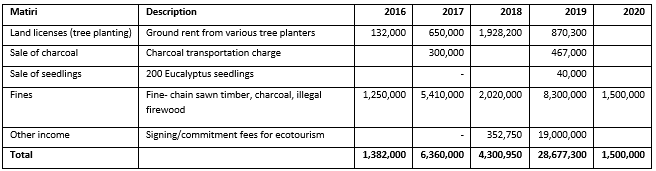
The main sources of revenue for the MPA are ground rent and non-timber products, table 8. The revenue has been very low and even declining and this trend needs to be reversed since there are more challenges that need to be funded in the MPA.
The revenue sources need to move towards non- consumptive uses of the forests especially ecotourism, sale of carbon credits and research. Table 9 shows the total revenue collected in the last 5 years 2016 to 2020.
Table 9: Revenue for Matri MPA 2016- 2020 (UGX)
Source: NFA
¶ 2.9.2 Expenditure
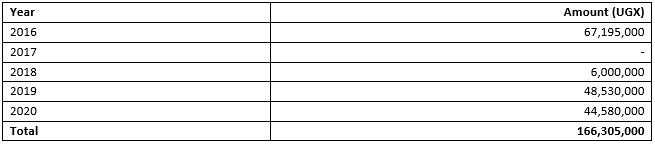
The expenditure was incurred on forest restoration and protection, vehicle running costs, salaries and wages. The expenditure has been increasing and far beyond the revenue collected, table 10. Nevertheless, the expenditure falls far below what is required to address the challenges of management of the MPA including ensuring that the CFR integrity is secured. Table 10 below shows the direct expenditure for the period 2016 -2020.
Table 10: Annual Expenditures in the Matiri MPA from 2017/18 – 2019/20 (UGX)
Source: NFA Finance Unit